SPW
The bulkheads are made up of a relatively thin vertical structure, driven into the ground up to a certain depth underneath the dredge level, so as to obtain a support solid enough to oppose the thrusts of the ground, of water and of possible overloads. This type of supporting structure can be made up of prefabricated and embedded sheet piles, drilled piles, diaphragms in reinforced concrete constructed in site and sometimes also of reinforced concrete panels.
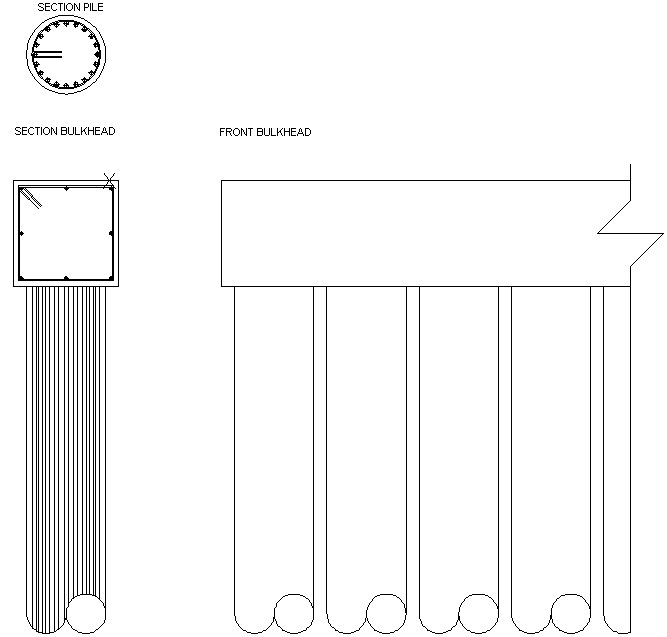
Diagram of a bulkhead built by placing reinforced concrete piles close to each other
The most widely used calculation methods are the following:
While the limit equilibrium method is based on considerations which are only and exclusively of static nature, for the finite-elements method considerations also based on the congruence of the deformations (the FEM method is thus a more rational method). The mentioned methods have a growing complexity both from the numerical point of view and in terms of preliminary operations for the calculation. In fact, while for the LEM method it is necessary to know the classical properties of the soil (angle of internal friction, etc.) for the FEM method it is also necessary to estimate the modulus of subgrade reaction of the ground and characterize its possible non-linear behaviour. The SPW software allows to perform the analysis of cantilever, anchored or braced bulkheads according above mentioned calculation methods.
GENERAL FEATURES (As regards the software input)
SPW software is able to analyze the models that are representative for most of the problems met in current practice. From a general point of view (we will go into details in the following sections), the main features of the input are the following:
GENERAL FEATURES (As regards the calculation phase)
GENERAL FEATURES (As regards the output phase)