F.E.M. - Finite element method
According to the finite element method, the soil is schematized with springs whose characteristics depend on the elastic modules of the soil, differentiating those in compression by those in tension. Bowles proposed to calculate, in an approximate way, the value of Ks (reaction module that is connected to the stiffness of the soil) on the basis of the bearing capacity of the foundations. The method provides directly, after building the global stiffness matrix and the vector of nodal loads, the deformations and, from these, the moments and the nodal reactions. For the calculation of the bulkhead proceed as follows:
(a) Calculation of the side pressure to the dredge line
(b) Set a depth for the first attempt
(c) Estimation of the value of Ks below the dredge line
(d) Arrangement of nodes where are assigned the stiffness of the springs
(e) Establish a trial section and calculation of the inertia moment of the section
(f) Stiffness calculation of any anchors
(g) Assemble the global stiffness matrix
(h) Assembly of the vector of nodal loads
(i) Calculation of the nodal displacements
The calculation is solved by an iterative procedure. The iterations continue until the displacements on the dredge line, between two cycles of calculation, are included in a tolerance value specified. The environment for the management of certain data related to implementation of the finite element method is the following:
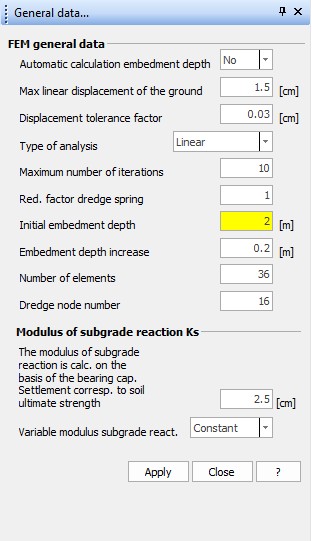
FEM general data
Modulus of subgrade reaction Ks
 Using the F.E.M. method can be checked an embedment depth assigned by the user (for example, to verify existing bulkheads), by selecting No for the automatic calculation of the embedment depth and set to 1 the maximum number of iterations (imposed automatically) and assign the desired initial embedment depth.  |
|---|