Stratigraphy
Different soil layers can be defined in the stratigraphy window:
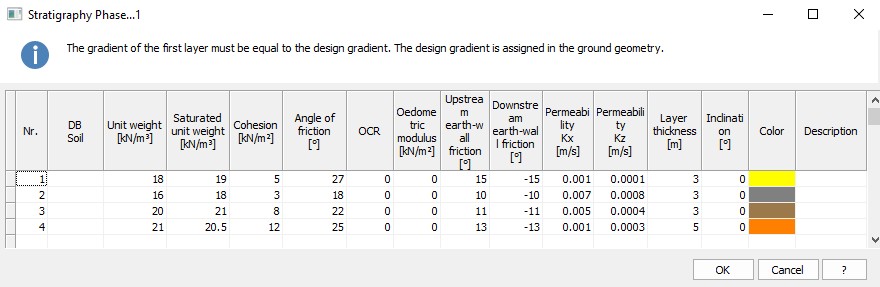
For each layer, the following data must be defined:
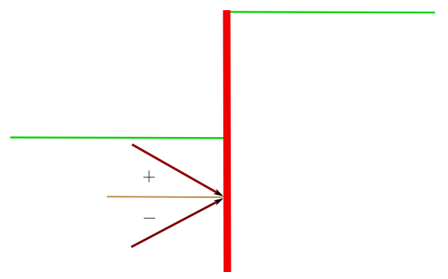
Direction of the passive thrust
The soil-downstream wall friction angle must be less than j/2. Otherwise it is necessary to consider the non-coplanarity of the sliding surfaces.
Some clarifications must be made as regards the definition of the layer thickness and inclination.
Layer thickness: The thickness of the layer is measured along the vertical passing through the origin of the fixed reference system (which, bear in mind, coincides with the head of the bulkhead). For more clearness, please refer to the following figure:
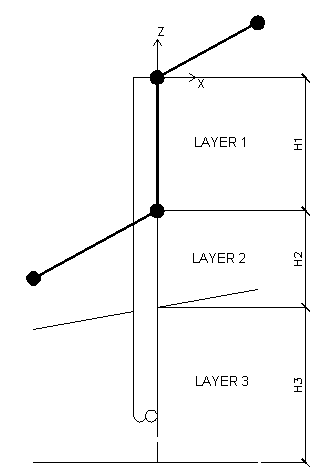
Layer inclination: The inclination of the layer is the angle of rotation relevant to the bottom of the layer taken into consideration. The rotation of the layer is defined with regard to the pole obtained through the intersection between the vertical line passing through the origin and the horizontal line which identifies the lower part of the layer to be defined.
When the embankment is made up of cohesive soil, traction zones can be expected to occur.
You don’t have to rely on the traction zone to reduce lateral pressure. Instead, it must be assumed that it can be formed and filled with water.
In the presence of a traction zone it is suggested to adopt both the indications shown in the figure, to consider the traction block as an overload and to consider the thrust of the water contained in the traction fractures.
It is known that cohesive soils tend to lose cohesion when exposed to excavation due to moisture absorption and/or formation of tensile fractures.
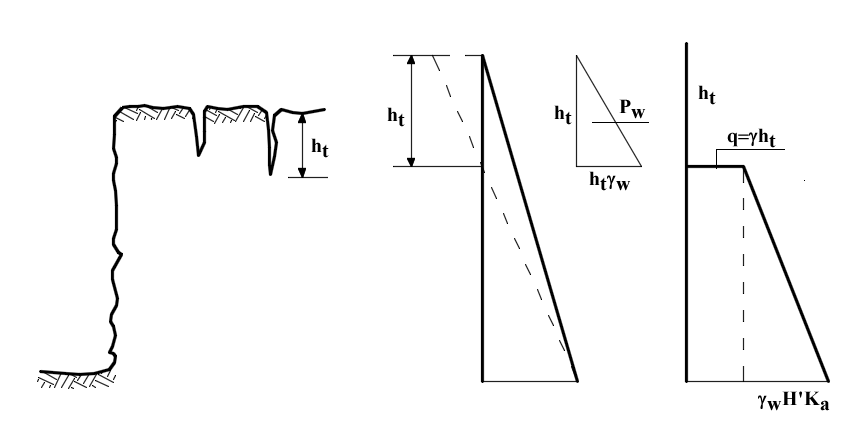
Tensile fractures and pressure diagram suggested in the presence of cohesive soils